Tax Planning Is a Year-Round Discipline
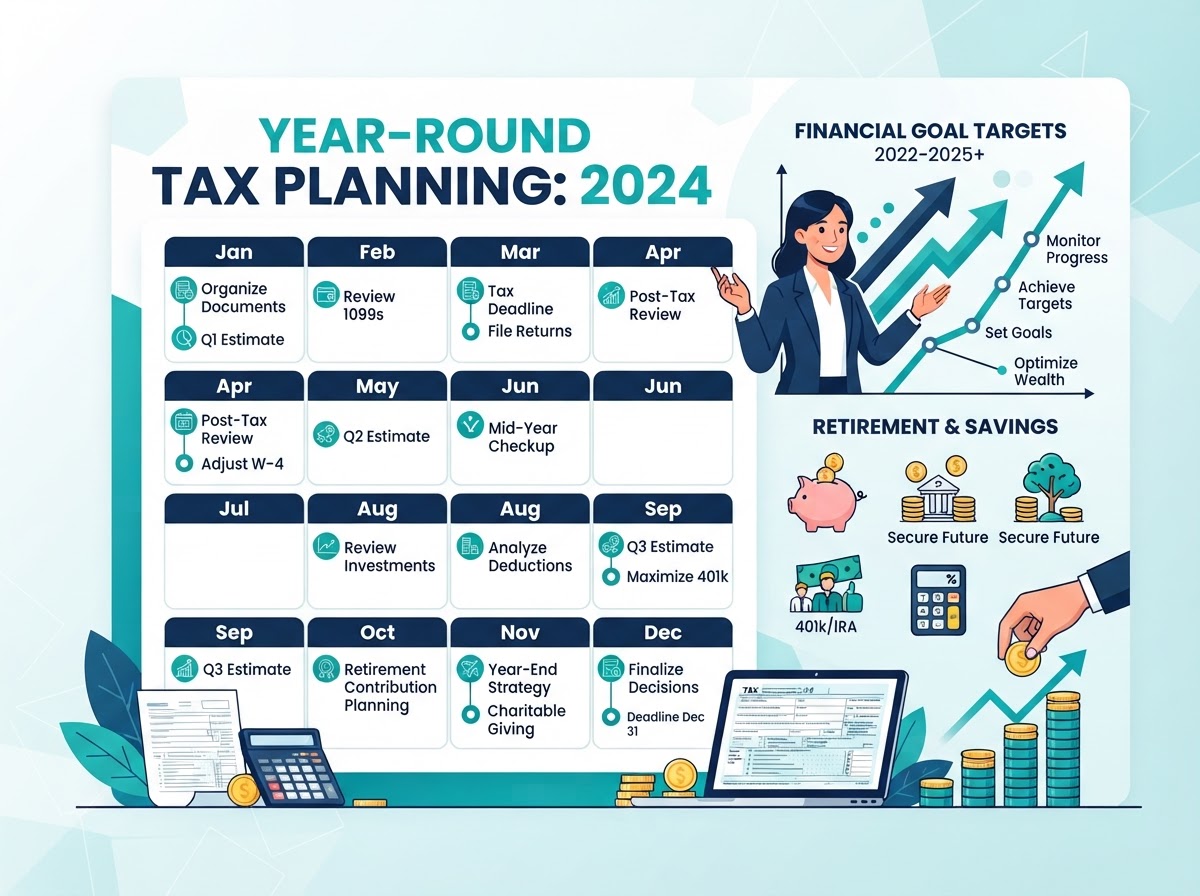
Most taxpayers think about taxes twice a year: when they file in the spring and when they scramble at year-end. The filers who pay the least — legally — are the ones who treat tax planning as a year-round discipline, making moves throughout the year that compound into meaningful savings. The period between now and December 31 is your last window to shape your 2026 tax outcome, and the moves below are the highest-leverage ones available.
Every strategy here has a deadline of December 31, 2026. After that, the year closes and your options narrow to the handful of deductions you can still make — primarily retirement contributions funded before the filing extension deadline. Acting now, while the window is open, is the difference between a tax bill you accept and one you actively shaped.
1. Max Out Retirement Contributions
The single most powerful tax-reduction move available to most filers is maxing out a retirement account. For 2026, the 401(k) contribution limit is high, and the IRA limit is meaningful for those without a workplace plan. Every dollar contributed reduces your taxable income dollar-for-dollar, and the growth is tax-deferred until withdrawal. A filer in the 22% bracket who maxes a 401(k) saves thousands in federal tax alone.
If you are self-employed, a SEP-IRA or Solo 401(k) allows even larger contributions based on your net earnings, and the deadline extends to the filing deadline of your return with extensions. This makes retirement funding both the most powerful and the most flexible year-end move — powerful because the deduction is large, flexible because you can still act after December 31.
2. Harvest Investment Losses
Tax-loss harvesting is the practice of selling investments that have lost value to realize the loss for tax purposes, offsetting capital gains and up to $3,000 of ordinary income per year. If your portfolio has positions in the red, selling them before December 31 locks in the loss. You can then reinvest in a similar (but not substantially identical) security to maintain your market position.
The wash-sale rule disallows a loss if you buy the same or a substantially identical security within 30 days before or after the sale, so careful replacement is essential. For investors with significant unrealized losses, harvesting can eliminate a year's capital gains tax liability entirely and create a carryforward that offsets future gains for years to come.
3. Bunch Charitable Contributions
With the standard deduction higher than ever, most filers no longer benefit from itemizing, which means charitable contributions do not reduce tax. The workaround is bunching: consolidating multiple years of giving into a single year to exceed the standard deduction threshold. A filer who gives $5,000 per year can instead give $15,000 in one year, taking the standard deduction in the other two years.
A donor-advised fund makes this strategy even more powerful by letting you take the deduction in the bunched year while distributing the gifts to charities over several years. This is one of the most effective planning moves for charitably inclined filers, and it pairs well with appreciated stock gifts that avoid capital gains tax on the appreciation while still generating a full deduction.
4. Use Your FSA and HSA
Health Savings Accounts offer a rare triple tax advantage: contributions are deductible, growth is tax-free, and withdrawals for qualified medical expenses are tax-free. For 2026, the HSA contribution limit is meaningful, and the deadline to fund an HSA extends to the filing deadline — giving you extra time even after year-end. Maximizing an HSA is one of the most tax-efficient moves available.
Flexible Spending Accounts have a use-it-or-lose-it rule, so year-end is the time to schedule eligible medical expenses — eyeglasses, dental work, prescriptions — before the balance expires. Some FSAs allow a carryover or grace period, but confirming the rules of your specific plan before December 31 ensures you do not leave money behind.
5. Defer or Accelerate Income
If you expect to be in a lower bracket next year, accelerating income into 2026 — a year-end bonus, a Roth conversion, invoicing clients early — can lock in the lower rate. If you expect higher income next year, the opposite applies: deferring a bonus, postponing a Roth conversion, or delaying invoices shifts income into the lower-bracket year. The strategy depends on your specific projection.
Self-employed filers have the most flexibility here, as they control billing and can time the receipt of income. A consultant expecting a large new contract in 2027 might accelerate 2026 invoicing, while one with a windfall this year might defer. These moves require a clear picture of both years' income, which is why a year-end planning session is so valuable.
6. Review Withholding
If you are on pace for a large balance due in April, adjusting your withholding for the final pay periods of 2026 can reduce or eliminate an underpayment penalty. The IRS charges interest on underpayments, and while the rate is modest, it compounds — and the penalty can be avoided entirely if you withhold at least 90% of the current year's tax or 100% of the prior year's.
Conversely, if you are over-withholding and expect a large refund, you are lending the IRS money interest-free. Adjusting your W-4 to match your actual liability puts that money back in your paycheck each month rather than as a lump sum the following spring. Either way, a withholding review in the fall is a quick, high-value move.
7. Document and Organize
The final year-end move is not a tax strategy per se but the foundation for all of them: gathering and organizing your documents. Charitable receipts, medical expense logs, mileage records, business expense tallies, and education receipts are all far easier to compile in December than in April. A folder — physical or digital — started now and updated weekly through year-end makes filing a matter of hours rather than a weekend of scrambling.
This is also the moment to schedule a year-end planning session with a professional. The value is not just the strategies above but the personalized review of your specific situation — your income, your dependents, your state, your investments — that determines which moves apply and how much each saves. The session pays for itself many times over, and the cost is deductible.
The Window Is Open Now
Every strategy in this list has a deadline, and for most of them that deadline is December 31, 2026. After the ball drops, your options narrow and your tax bill becomes a fact rather than a variable. The filers who pay the least are the ones who act in the fall, when the planning window is open and the moves still matter.
If you have not yet planned for 2026, now is the time. Our year-end planning sessions are designed to identify every applicable strategy for your specific situation, quantify the savings, and create a checklist you can execute before December 31. The difference between a planned return and an unplanned one is often thousands of dollars — and that difference is made in the next few weeks.