The Most Powerful Deferral in the Code
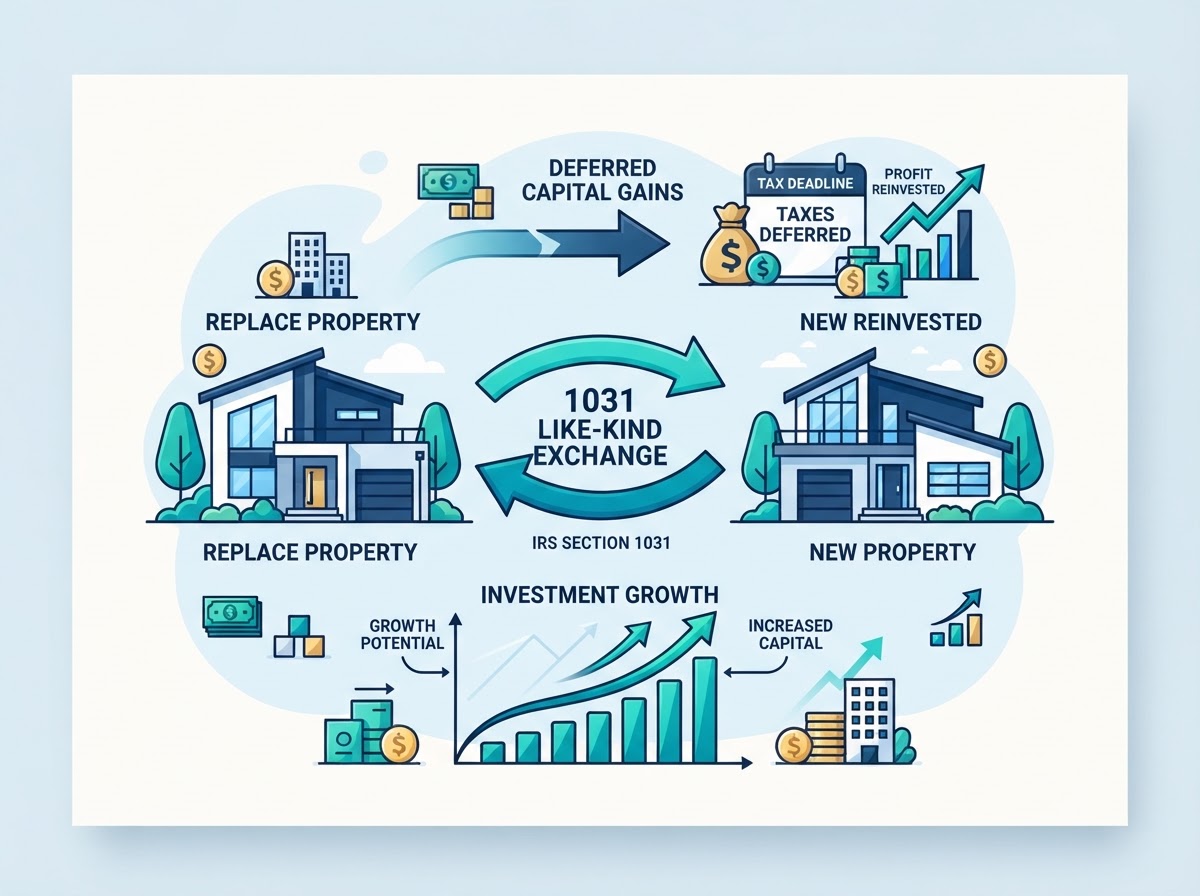
Section 1031 of the Internal Revenue Code is one of the most powerful tax-deferral provisions available to real estate investors. It allows an investor to sell an investment property and reinvest the proceeds in another like-kind property, deferring the capital gains tax that would otherwise be due on the sale. For properties with significant appreciation, the tax deferred can amount to tens or hundreds of thousands of dollars — money that stays invested and compounding instead of going to the IRS.
The provision is not a loophole; it is a deliberate policy choice to encourage the reinvestment of capital in productive real estate. But the rules are strict, the deadlines are absolute, and the consequences of a misstep are severe — including the immediate recognition of all deferred gain. Understanding how a 1031 exchange works is essential for any real estate investor considering a sale.
What Qualifies as Like-Kind
Real property is remarkably broad under the like-kind definition. Any real property held for investment or for use in a trade or business qualifies as like-kind with any other such property — a rental house can be exchanged for an apartment building, a commercial property for raw land, a retail space for an office building. The properties do not need to be similar in type, only in nature — both must be investment or business real property.
What does not qualify: a primary residence, property held primarily for sale (dealer property), and personal property. The 2017 tax law changes eliminated personal property from 1031 eligibility, so vehicles, equipment, and other tangible personal property can no longer be exchanged. Real estate, however, remains fully eligible, which is why 1031 remains a cornerstone of real estate tax planning.
The Timing Rules
A 1031 exchange is governed by two absolute deadlines. First, the investor must identify the replacement property or properties within 45 days of closing the sale of the relinquished property. Second, the investor must close on the replacement property within 180 days of the sale — or by the filing deadline of the tax return for the year of the sale, including extensions, whichever is earlier. These deadlines are not extendable; missing either disqualifies the exchange.
The 45-day identification rule allows up to three properties to be identified regardless of value (the three-property rule), or more under the 200% or 95% rules. The identification must be in writing, signed, delivered to a qualified party, and unambiguous — a street address or legal description. Many exchanges fail because of sloppy identification, which is why working with a qualified intermediary from the start is essential.
The Qualified Intermediary
The investor cannot touch the proceeds from the sale — if they do, the exchange is dead and the gain is recognized. The proceeds must be held by a qualified intermediary, a neutral third party who holds the funds, prepares the exchange documents, and facilitates the identification and closing. The QI is not optional; it is a structural requirement, and choosing a reputable one is critical because the funds are at risk if the QI fails.
The QI prepares the exchange agreement, holds the proceeds in a segregated account, and coordinates with the closing agents on both sides. The cost is modest relative to the tax deferred, and the protection is essential — without a QI, the exchange cannot proceed. Investors should vet the QI for experience, bonding, and segregated account practices before engaging.
What Is Deferred and What Is Not
A 1031 exchange defers the capital gains tax on the appreciation of the relinquished property, but it does not eliminate it — the gain carries forward to the replacement property, which takes on a substituted basis. The deferral continues each time you exchange, and the gain is ultimately recognized when you sell for cash or die — though at death, the basis steps up to fair market value, eliminating the deferred gain entirely.
This is the powerful long-term strategy: exchange throughout your lifetime, deferring gains at each step, and let the step-up at death eliminate the accumulated gain. For investors with substantial appreciated real estate, this is the single most effective estate planning tool available — and it pairs with the ability to exchange into properties that produce better cash flow or better appreciation prospects, improving the portfolio while deferring the tax.
Boot and Partial Exchanges
If the replacement property costs less than the relinquished property sold for, the difference — called boot — is taxable. Similarly, if any debt is paid off and not replaced, or if the investor receives cash, that portion is taxable. The goal is to match or exceed the value and the debt of the relinquished property in the replacement, to defer the full gain.
A partial exchange — where some gain is recognized and some is deferred — is common and still worthwhile if the deferral is significant. The mathematics require careful planning: the replacement property value should equal or exceed the relinquished value, and the new debt or cash should equal or exceed the old debt. A preparer or QI can model the outcome before closing to ensure the maximum deferral.
When a 1031 Makes Sense
A 1031 exchange makes sense when you have significant appreciated equity in an investment property, you want to reinvest in other real estate, and you can identify and close within the strict timelines. It does not make sense if you need the cash, if the gain is small, or if you cannot find suitable replacement property within 45 days — in which case a sale with taxed gain may be simpler.
For investors with a portfolio of appreciated properties, 1031 is the single most powerful tool for deferring gains, improving the portfolio, and ultimately eliminating the gain through the step-up at death. Our real estate team has facilitated hundreds of exchanges, coordinated with QIs and attorneys, and structured the identification and closing to maximize deferral. If you are considering a sale, talk to us first — the planning must happen before the sale closes, not after.