The Choice That Shapes Your Return
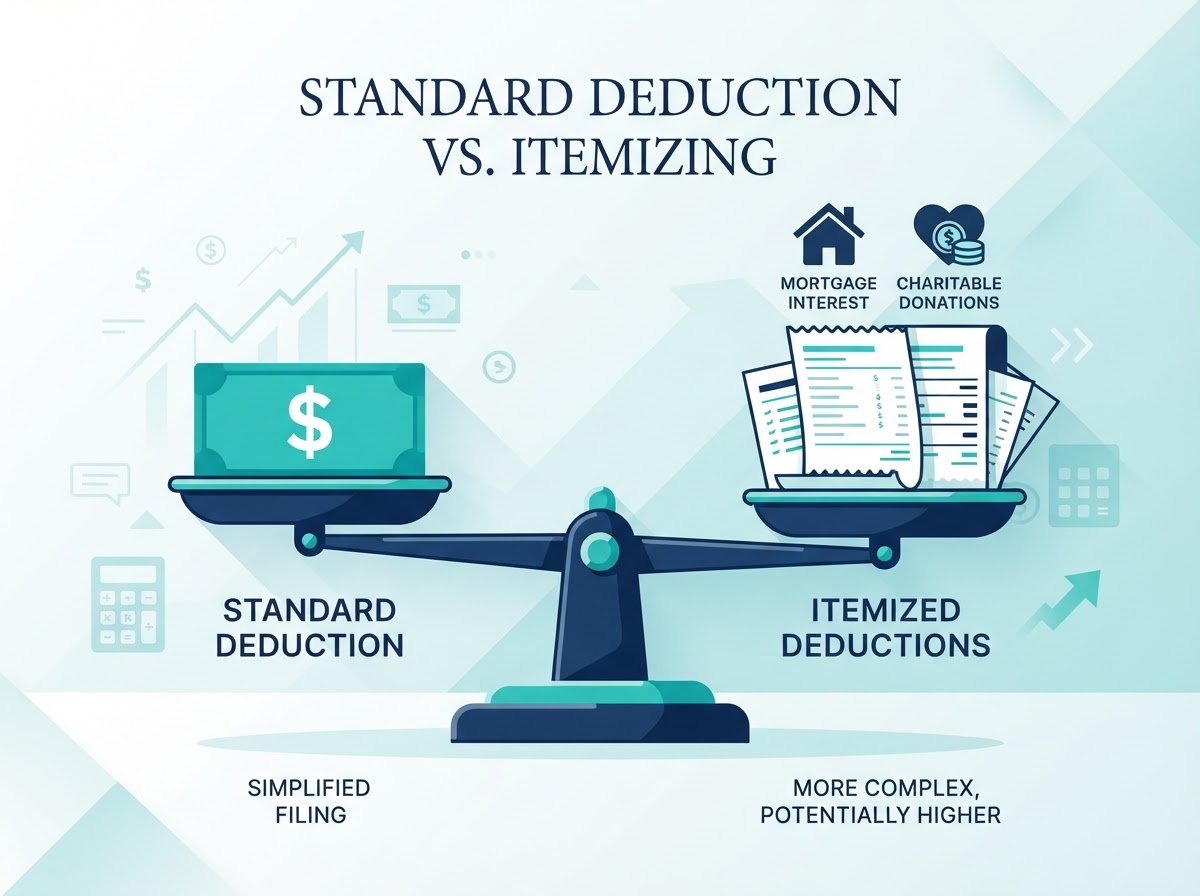
Every tax filer faces the same fundamental question: take the standard deduction or itemize? It is the single most consequential decision on a personal return, because whichever path you choose becomes the foundation that reduces your taxable income. Choose correctly and you minimize your tax; choose poorly and you pay more than necessary — sometimes thousands more.
The good news is that the choice is mechanical: you calculate both and take the larger. The challenge is that itemizing requires documentation that many filers do not maintain, and the standard deduction has grown so large that fewer filers benefit from itemizing each year. Understanding when itemizing wins — and when it does not — is the key to not overpaying.
The 2026 Standard Deduction
For 2026, the standard deduction is $16,200 for single filers, $24,400 for married filing jointly, and $24,400 for Head of Household. These figures are adjusted annually for inflation and represent the amount of income you can earn tax-free before the brackets apply. Over 85% of filers take the standard deduction, and for most, it delivers more savings than itemizing would.
The standard deduction requires no documentation — you simply claim the amount for your filing status. It is the default, and the IRS does not question it. For filers without significant mortgage interest, state and local taxes, or charitable contributions, the standard deduction is almost always the better choice, and the simplicity is a feature, not a limitation.
When Itemizing Wins
Itemizing wins when your total of deductible expenses exceeds the standard deduction for your filing status. The main categories are: state and local taxes (income or sales, plus property, capped at $10,000), mortgage interest on up to $750,000 of acquisition debt, charitable contributions (cash up to 60% of AGI, appreciated assets up to 30%), and medical expenses above 7.5% of AGI.
The filers most likely to benefit from itemizing are those with large mortgages, high state and local taxes, significant charitable giving, or substantial unreimbursed medical expenses. A married couple with a $15,000 mortgage interest, $10,000 in property and state taxes, and $5,000 in charitable contributions has $30,000 of itemized deductions — more than the $24,400 standard — and itemizing saves them real money. The math is straightforward; the documentation is the hurdle.
The SALT Cap and Its Effect
The $10,000 cap on state and local tax deductions — known as the SALT cap — is the single biggest reason itemizing no longer benefits most filers in high-tax states. Before the cap, a filer in a high-income-tax state could deduct the full amount of state income tax, which often exceeded the standard deduction on its own. With the cap, that deduction is limited, and the combined SALT total rarely clears the threshold for most filers.
The effect is that even filers in high-tax states often take the standard deduction, because the SALT cap plus mortgage interest rarely exceeds $24,400 for a married couple unless there is significant giving or medical expense. This is a planning consideration: if you are near the threshold, bunching charitable contributions or timing medical expenses into a single year can push you over and make itemizing worthwhile for that year.
How to Decide
The decision is mechanical: total your itemized deductions and compare to the standard deduction for your filing status. If itemizing is higher, itemize; if not, take the standard. The trap is not the comparison but the documentation — if you cannot substantiate your itemized deductions with receipts and records, the IRS can disallow them on audit, and you will have lost both the deduction and the accuracy.
A practical approach is to maintain records of deductible expenses throughout the year — a folder for charitable receipts, a log of medical expenses, a summary of mortgage interest and property taxes — and to total them in January before filing. If the total approaches the standard deduction, consult a preparer who can confirm the comparison and ensure the documentation is audit-ready. If the total is well below the standard, take the standard and save the documentation effort.
Married Filing Separately Considerations
A subtle wrinkle affects married couples: if one spouse itemizes, the other must also itemize — they cannot take the standard deduction. This means the decision is joint, and if one spouse has significant deductions and the other does not, the couple may be worse off filing separately than jointly. The analysis requires running both scenarios, which is why most married couples file jointly unless there is a specific reason to separate.
Filing separately also halves the standard deduction (each spouse gets $12,200 for 2026) and disqualifies several credits. The rare cases where it makes sense typically involve large medical expenses — the 7.5% AGI threshold is easier to clear on a single income — or liability concerns. In nearly all other cases, filing jointly delivers the better outcome.
The Bottom Line
The standard deduction is larger for 2026 than ever before, and for most filers it is the right choice. But the only way to know for certain is to run the numbers — total your itemizable expenses and compare. The difference between the right choice and the wrong one can be thousands of dollars, and the comparison takes minutes with the right records.
Our preparers run this comparison for every client as a matter of course, because the standard-versus-itemized decision is the foundation of the return. If you have not confirmed which path is better for your 2026 return, a fifteen-minute review can tell you — and the savings, if itemizing wins, are yours to keep. The standard deduction is a floor, not a ceiling; the question is whether your deductions rise above it.