Two Forms, Two Worlds
The distinction between a W-2 employee and a 1099 independent contractor is one of the most consequential classifications in the American tax system. It determines who pays payroll taxes, what deductions are available, whether you can contribute to a workplace retirement plan, and how you file your return. Getting this wrong — either as a worker or as a business — can mean thousands in back taxes, penalties, and interest.
The line between the two is not about job title or industry but about the nature of the working relationship. The IRS evaluates three categories: behavioral control, financial control, and the type of relationship. Understanding these categories is the key to knowing which form applies to you and to filing correctly when tax season arrives.
The W-2 Employee
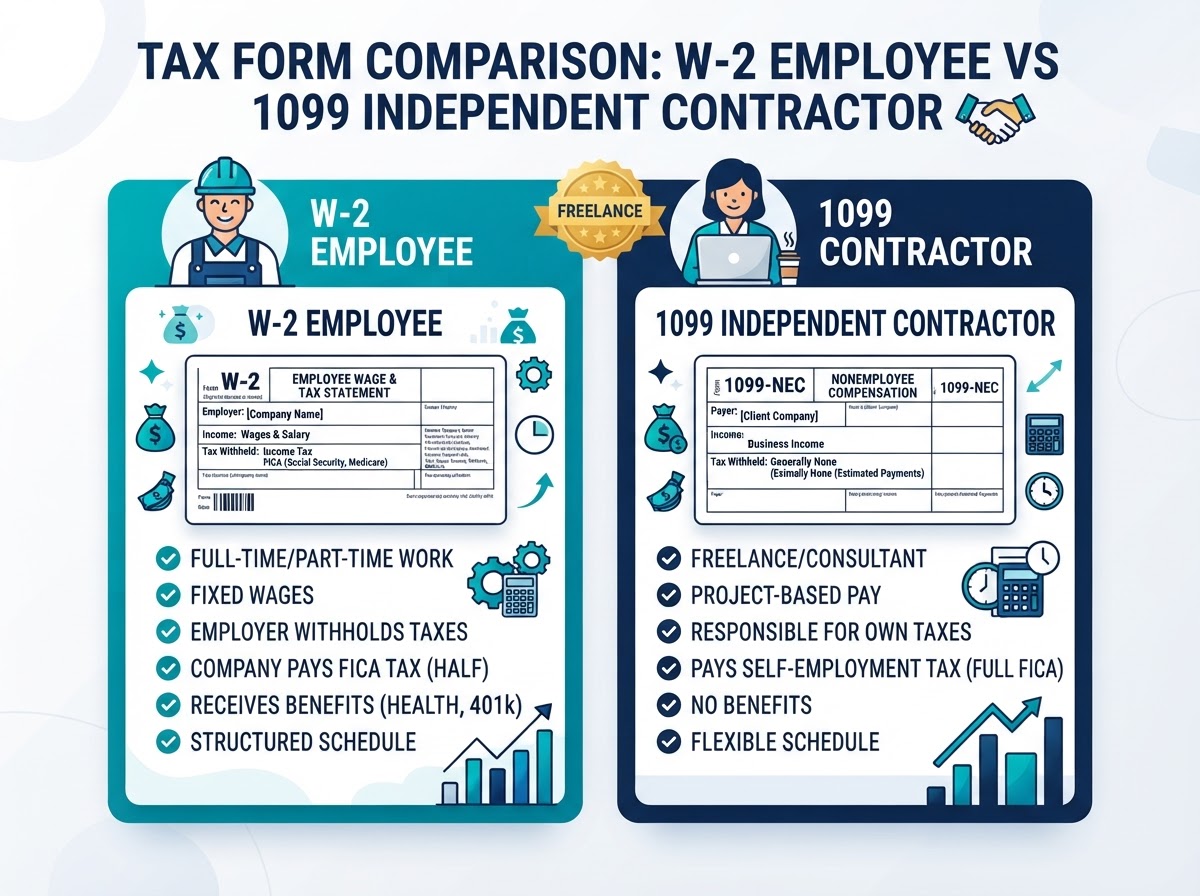
A W-2 employee is a worker whose employer controls what work is done and how it is done. The employer sets the hours, provides the tools, directs the methods, and integrates the worker into the business. In return, the employer withholds federal and state income tax, pays half of the payroll taxes (Social Security and Medicare), and issues a W-2 form at year-end summarizing wages and withholdings.
For the employee, this means simpler filing — the employer handles withholding, and the W-2 shows the wages and tax already paid. The trade-off is fewer deductions: employees cannot deduct unreimbursed business expenses for 2018 through 2026 under current law, which means a home office, mileage, or tools purchased for work are generally not deductible. The simplicity comes at the cost of lost deductions.
The 1099 Independent Contractor
A 1099 independent contractor is a worker who controls how the work is performed, typically uses their own tools, and offers services to the public or to multiple clients. The payer does not withhold taxes, does not pay half of payroll taxes, and issues a 1099-NEC (or 1099-K for certain payment platforms) summarizing the payments made. The contractor is responsible for the full self-employment tax and for making their own estimated tax payments.
The trade-off runs the other way: more complex filing, but far more deductions. A contractor can deduct all ordinary and necessary business expenses — home office, mileage, equipment, software, professional development — which substantially reduces taxable income. The self-employment tax is offset by a deduction for half of it, and the net business income qualifies for the 20% Section 199A QBI deduction. The complexity is real, but so are the savings.
The IRS Three-Category Test
When the IRS evaluates whether a worker is an employee or a contractor, it looks at three categories. Behavioral control considers whether the business directs or controls how the work is done — instructions, training, and evaluation. Financial control considers whether the worker has a significant investment, unreimbursed expenses, and the ability to realize a profit or loss. Relationship type considers written contracts, benefits, and permanency.
No single factor is decisive; the IRS weighs all three. A worker who sets their own hours but uses the employer's tools and receives training tilts toward employee. A worker who uses their own equipment, has multiple clients, and can realize a loss tilts toward contractor. Businesses that misclassify employees as contractors — intentionally or not — face back taxes, penalties, and interest, which is why getting this right matters on both sides.
Tax Implications for the Worker
For a 1099 worker, the key obligations are tracking income and expenses, making quarterly estimated tax payments, and filing Schedule C with the 1040. The self-employment tax — the full Social Security and Medicare — is calculated on net earnings, and quarterly payments are required if you expect to owe more than $1,000 at year-end. Missing quarterly payments triggers an underpayment penalty even if you pay by April 15.
The flip side is the deductions. A contractor earning $60,000 with $15,000 in deductible business expenses pays tax on $45,000 of net profit, not $60,000 — and that net profit qualifies for the QBI deduction. The record-keeping burden is real, but the tax savings from accurate expense tracking often exceed the cost of a preparer many times over. This is why most successful contractors work with a tax professional throughout the year.
Tax Implications for the Business
For a business engaging workers, the classification determines payroll obligations. Employees require payroll tax withholding, employer payroll tax matching, workers' compensation coverage, and benefit eligibility. Contractors require none of these, which is why businesses sometimes prefer the 1099 model — but misclassifying an employee as a contractor to avoid payroll taxes is a serious violation that can trigger back payroll taxes plus penalties.
The safest approach for a business is to apply the three-category test honestly and to document the basis for the classification. A written contractor agreement, evidence of the worker's independent business (multiple clients, their own tools, their own insurance), and a clear absence of behavioral control all support the 1099 classification. When in doubt, a tax professional or employment attorney can confirm the proper treatment.
Choosing the Right Path
For workers, the choice between W-2 and 1099 is often not a choice at all — it depends on the work and the employer. But for workers with flexibility, understanding the trade-offs matters: W-2 simplicity and employer-paid benefits versus 1099 deductions and flexibility. For high-earning contractors, the tax savings from deductions and the QBI deduction can more than offset the self-employment tax, making the 1099 path the better deal after tax.
For businesses, the choice carries real risk and real cost. Our team advises small businesses on worker classification, sets up compliant payroll and contractor agreements, and prepares both W-2 and 1099 returns. The goal is always the same: the right classification, the right documentation, and the right tax outcome — with no surprises from the IRS down the road.